Your clothes, from a small beginning
From your clothes to your next look.
Start with a few photos. Check the details you want to keep. Bring familiar pieces together in a look.
A few favourites will do.
Begin with the clothes you return to. A clear photograph is a useful starting point; you do not need to organise an entire wardrobe before trying the idea.
Start with the photo example ↗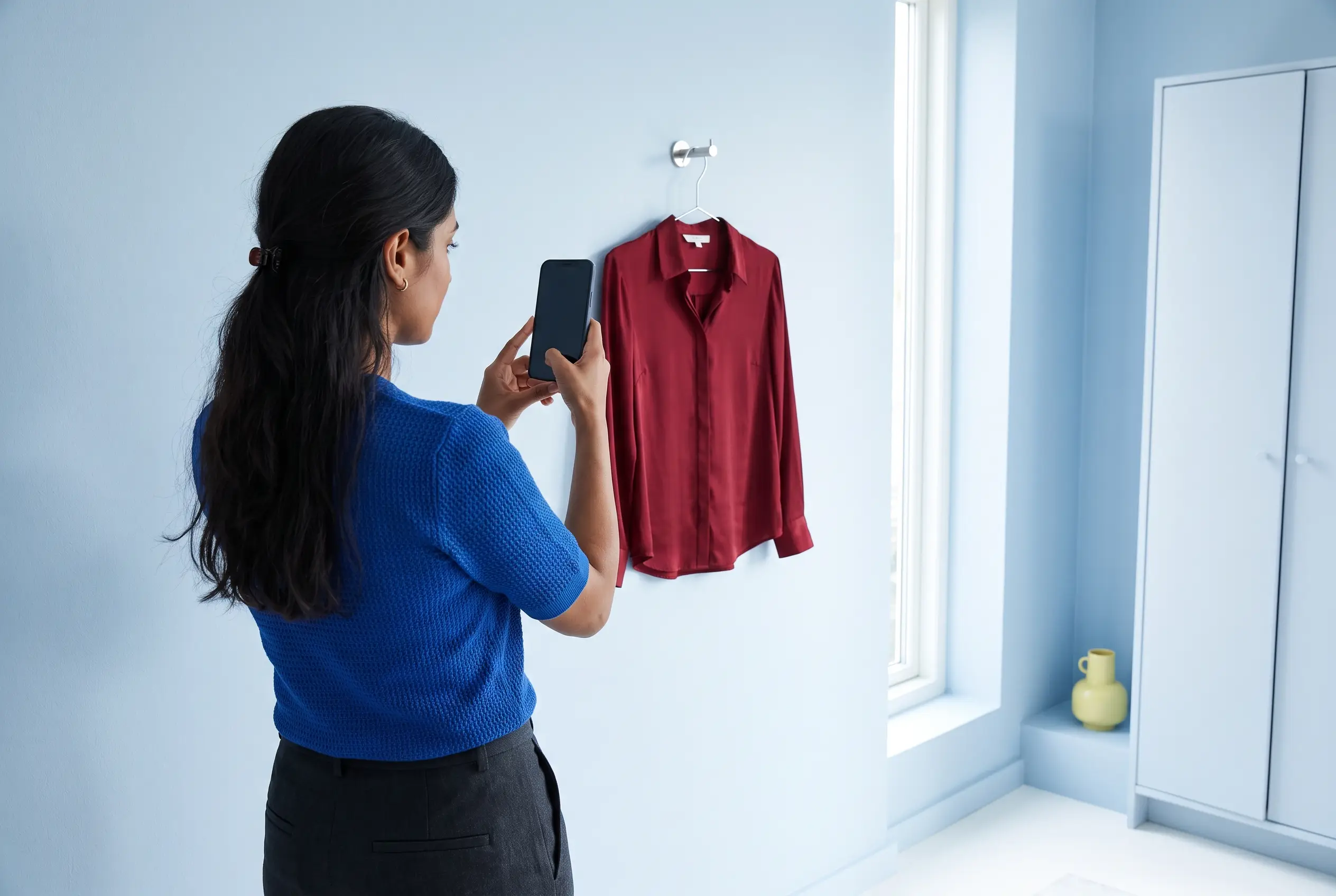
You decide what stays.
Review suggested details beside the source photo. Correct a label, choose the pieces to keep, or leave one out. A suggestion is a starting point for your review.
Try correcting a sample piece ↗The public example uses prewritten details. It does not process a personal photo or save clothing to an account.
Put the pieces together.
A different top changes the look without replacing the whole wardrobe. Start with an example combination, then make a small change.
Open the workday combination ↗Measurements, appearance previews and the detailed product context
These are separate from cataloguing your clothes. The existing explanations and their limitations remain below.
How it works
From your clothes
to your next look.
Choose photos, review suggested details, and decide which pieces to keep. Bring them together into looks you can return to.
The separate body-measurement workflow
A guided capture is designed to become a versioned set of measurement estimates, then a garment template, a digital closet, an on-you preview, and size guidance where the evidence supports it. This design illustrates the measurement workflow. Measurement estimates are uncalibrated and personal fit guidance remains unavailable; see service status.
The whole app journey
Six stages. One evidence trail.
Choose a stage to inspect the app screen. The phone keeps the same body record in view while the job changes around it.
Concept reference
No personal capture shown
Turn slowly
In frameVoice and haptics guide the pace
VersionedProvenance, confidence, date
Garment-specificBase estimate stays unchanged
Captured by youReview category, colour, and fabric
Appearance viewFit evidence remains separate
Hypothetical evidence example. Personal size recommendations are currently unavailable.
Best-supported matchChest and sleeve supported
Evidence shownMissing zones would be named
Concept illustration. All values, garments, and results are fictional.
Built like a record
Nothing important arrives without its context.
Every available value can carry how it was derived, how strong the evidence is, which scan produced it, and when that scan happened. Later features read that record instead of rewriting it.
A guided phone scan
The app guides your distance, position, clothing, and light. If the capture conditions are not supported, it names the issue and offers one next action. A scan can be retried without creating a misleading result. Processing runs on the Alex Folzi estimator, so no outside scan vendor receives your photographs. Measurements are uncalibrated, and fit guidance is declined until a calibration study is complete.
Raw capture photos are deleted within 24 hours after successful processing and immediately after failed or abandoned processing.
A version, not an overwrite
Each completed scan creates a dated version. A later scan does not erase the earlier estimate. You can see which version is current and remove a scan when you choose.
- Estimated
- Calculated from the captured geometry and provider method.
- Observed
- Supported more directly by visible landmarks in the capture.
- Inferred
- Derived with more assumptions or limited source evidence.
Two ways to use the result
Measurement spec sheets
Create a dated export for a garment maker or your own records. The export includes units, definitions, source type, confidence, intervals where available, and the scan and template versions used.
Per-brand size guidance
Where reviewed garment data is available, Alex Folzi compares the relevant measurement zones, garment construction, and your fit preference. The result shows the best-supported size, adjacent-size considerations, missing data, and why confidence may be limited. When the evidence is too weak, the product does not suggest a size.
What stays separate
Room is reduced to private deliberate sharing. Discovery, follows, comments, reactions, and public profiles are unavailable.
Optional model training, brand or merchant sharing, and social sharing each require a separate choice.
The planned mobile launch target is iPhone 12 or later, iOS 17 or later, United States, and adults 18 and over.
Try the review step
A photo.
A few familiar pieces.
Review, edit and select prewritten example garments before adding them to a temporary wardrobe.
Try a photo review example ↗This is an interactive example; photo processing is not connected.